






Morgan Housel, partner at the Collaborative Fund and author of The Psychology of Money, one of the bestselling finance books of the last decade, opens with a premise that still catches people off guard: "Financial success is not a hard science. It's a soft skill, where how you behave is more important than what you know."
It is a line that most finance graduates encounter after years of being trained in the exact opposite direction. That precision, technical mastery, and analytical rigour are the foundations of a successful finance career. And they are.
But Housel's point runs deeper than personal finance advice. It points to something the profession as a whole is now reckoning with at an institutional level: the skills that built careers in finance over the last thirty years are not the same skills that will define the next ten.
The world's largest employers know this. The data confirms it. And the finance professionals who are paying attention are already repositioning.
This blog covers what that repositioning actually looks like. Why the finance function is being fundamentally restructured by automation and AI, which 6 skills global employers are already demanding, and why the finance professionals who will matter most by 2030 are the ones who can read the shifting world dynamics as fluently as they read a balance sheet.
For those looking to build exactly that breadth, VIT's MBA in Finance is a good fit.
The Butterfly Effect: Why Finance Cannot Exist in a Bubble
In 1961, a meteorologist at MIT named Edward Lorenz made a discovery by accident. Running a weather simulation for the second time, he entered a starting value of 0.506 instead of the full 0.506127, a rounding difference so small it seemed trivial.
The simulation produced a completely different outcome. Lorenz had stumbled onto what would become one of the most consequential ideas in modern science: that in complex, interconnected systems, a tiny change in initial conditions can cascade into an outcome of staggering magnitude. He called it sensitive dependence on initial conditions. The world came to call it the butterfly effect.
Finance is exactly such a system. And the finance professionals who fail to understand this: who treat markets as closed, calculable, self-contained environments, are the ones who get caught off guard when the world does what it always eventually does: something that has never quite happened before.
Consider what has unfolded in global markets in early 2026.
The Strait of Hormuz, through which approximately 20 million barrels of oil pass every day, representing roughly 20% of global petroleum consumption is disrupted due to recent geopolitical events.
Shipping traffic through the strait fell to just 5% of pre-conflict levels. The S&P 500 fell 9% below its January peak. Oil prices, which Morgan Stanley had forecast at around $60 per barrel for 2026, are now expected to average $80 to $90 per barrel, with tail-risk scenarios above $130.
J.P. Morgan revised its global GDP growth forecasts downward and its inflation expectations upward. Central banks began adjusting policy in response.
None of this originated in a financial model. It began with geopolitics. Which began with diplomacy.
This is the butterfly effect in practice. A geopolitical conflict cascades into energy supply shocks, which cascade into inflation revision, which cascades into central bank policy adjustment, which cascades into equity market repricing, which lands on the desk of every CFO, fund manager, and financial analyst on earth. The chain is long. The initial conditions are political, not financial. And yet the outcomes are measured entirely in dollars.
This is not a new phenomenon. It is, in fact, one of the oldest lessons in financial history, and one that tends to be forgotten with remarkable regularity during periods of prosperity.
Having an MBA in Finance can help you develop and apply critical skills such as risk mitigation, strategic planning, capital allocation, financial forecasting, and scenario analysis.
The Roaring Twenties and the Lesson Nobody Learned in Time
The Roaring Twenties were fueled by innovation, optimism, and a widespread belief that prosperity would continue indefinitely. Between 1921 and 1929, stock markets soared; speculation surged, and investors borrowed heavily to chase returns. Yet beneath the excitement lay warning signs: excessive leverage, overproduction, and rising interest rates.
When Black Tuesday struck in October 1929, those vulnerabilities were exposed. The Dow eventually lost nearly 90% of its value, triggering the Great Depression. The lesson was simple but often forgotten; markets may evolve, but the fundamentals of risk do not.
Nearly a century later, financial journalist Andrew Ross Sorkin notes striking parallels between 1929 and today: transformative technologies, speculative enthusiasm, and growing confidence that "this time is different." History suggests otherwise.
Understanding these patterns is exactly why finance education matters.
VIT's MBA in Finance equips students with exactly these skills to interpret market signals, anticipate economic shifts, and make sound decisions in uncertain environments.
What This Means for the Finance Professional
The finance professional of 2030 cannot be a technician alone. Reading the market requires reading the world.
Understanding a risk scenario requires understanding history, buyer-seller emotion, and a lot more.
VIT's MBA in Finance is built around precisely this kind of breadth. We develop financial technicians who are commercially aware, globally literate finance leaders who can read market signals in their full context.
The Finance Industry Is Shifting
There is a telling statistic buried in the research that rarely gets the attention it deserves: between 2019 and 2021, approximately 300,000 accountants left the industry. Of those who departed in 2023, 82% had more than six years of experience.
According to Gartner's Finance 2030 analysis, this is not a cyclical dip. It is a structural exodus, driven by the collision of automation, shifting employer expectations, and a generation of finance professionals who realised the role they had trained for no longer existed.
This is the context in which the conversation about future finance skills must be held. It is not simply about adding new capabilities to an existing role. It is about understanding that the role itself is being redefined, and it calls for people in this field to be proactive.
The World Economic Forum's Future of Jobs Report 2025 is unambiguous on this point. By 2030, the proportion of tasks in the finance and capital markets sector expected to be managed by technology will rise from 21% to 38%.
Only 28% of tasks will be primarily human-driven down from 44% today. The sector is not disappearing. It is compressing around the parts that machines cannot do; judgement, communication, strategy, and the kind of contextual intelligence that no model can replicate.
What remains, what grows....is the domain of the finance professional who has built for this moment.
The Six Skills Global Finance Employers Will Prioritise by 2030
The following capabilities that finance employers will prioritise by 2030 are drawn from employer demand data, workforce research, and the evolving role of finance leadership across multinational organisations.
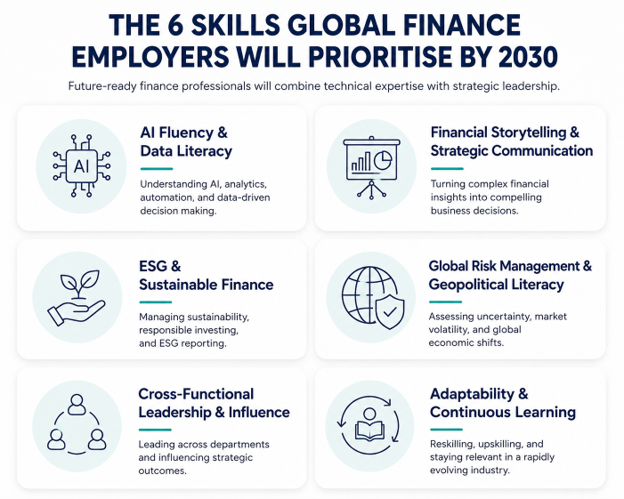
AI Fluency and Data Literacy
This is the non-negotiable. According to the World Economic Forum's Future of Jobs Report 2025, AI and big data skills are the fastest-growing capabilities across all sectors but the financial services industry faces a particularly acute gap, with 66% of financial organisations citing skills shortages as the primary barrier to transformation, and only 34% of finance employees currently undergoing reskilling compared to 50% across all other sectors.
Recognising this shift, VIT's Finance specialisation includes BUS6003: Financial Analytics, a unit designed to bridge the gap between financial theory and data-driven decision-making. Students learn to apply financial analytic modelling using industry-standard modelling tools and spreadsheets, while developing expertise in areas such as risk measurement, shareholder value analysis, capital budgeting, financial statement analysis, short-term financing, and project evaluation.
As finance becomes increasingly powered by data, analytics, and AI-enabled decision-making, the ability to build models, interpret complex datasets, and translate insights into strategy will be a defining competitive advantage.
Financial Storytelling and Strategic Communication
Workday's analysis of the evolving CFO role, captures the shift precisely: "With AI handling the heavy data lifting, the CFO's core value lies in their ability to contextualise and communicate insights." The focus is moving from backward-looking, quarterly reporting to forward-looking, real-time narrative - the kind of financial storytelling that informs C-suite decisions, influences board direction, and builds investor confidence.
ESG and Sustainable Finance
Perhaps no area of finance has moved from the periphery to the centre more rapidly than sustainable finance. According to the US SIF Foundation's Sustainable Investing Trends Report 2025/2026, U.S. sustainable investing assets under management total approximately $6.6 trillion, with broader global forecasts projecting double-digit annual growth rates of around 20% between 2026 and 2030.
The demand for professionals who can handle this space is already outpacing supply. Demand for sustainability and ESG expertise in finance roles rose from 38% to 47% between 2023 and 2024 alone.
LinkedIn's Climate Talent Stocktake 2025 found that workers with green skills are 46.6% more likely to be hired than the global average.
Global Risk Management and Geopolitical Literacy
The Kyriba CFO Survey found that CFOs cite using AI specifically to mitigate the impact of external factors including market and currency volatility, tariffs, and political instability on their organisation's financial health.
Risk management in this context requires professionals who understand how to model uncertainty, communicate risk scenarios to non-finance stakeholders, and make decisions under conditions that historical data cannot fully anticipate.
As Housel writes in The Psychology of Money: "Things that have never happened before happen all the time."
For finance professionals managing global portfolios, this is not a philosophical observation. It is a job description.
Cross-Functional Leadership and Influence
According to the Pitch Hill Partners analysis of the WEF report, senior finance roles are becoming more valuable. Employers are looking for leadership and social influence, resilience, and adaptability. These are not soft add-ons to technical roles. They are the capabilities that determine whether a finance professional can move from analyst to architect, from someone who produces insights to someone who drives organisational decisions.
Adaptability and Continuous Learning
New technologies, evolving regulations, emerging asset classes, and shifting economic conditions call for finance professionals to adopt emerging technologies, and lead organisations through periods of transformation. Those who combine strong financial foundations with a commitment to continuous learning will be well-positioned to take on new challenges, adopt emerging technologies, and lead organisations through periods of transformation.
Conclusion
To have the right skills to be a leading finance professional requires structured, academically grounded development that combines technical knowledge with strategic approach and a genuine understanding of the global business environment in which modern finance operates.
VIT's MBA in Finance equips graduates with exactly this integration. Financial acumen, strategic capability, critical thinking, and the global business perspective that the next generation of finance leaders will need.