





The rules of leadership are being rewritten, and the most effective leaders know that the future belongs to those who can feel as sharply as they think.
This blog explores why emotional intelligence has become the defining leadership competency of our time: what the research says, how the world's most effective leaders apply it, and what it means for the next generation of global managers.
Victorian Institute of Technology's MBA in Leadership and Management is built for managers of today, leading diverse teams.
The Leadership Landscape Has Changed
Global organisations today operate in an environment that would be almost unrecognisable to the management theorists of a generation ago. Cross-border teams collaborate across time zones. Remote and hybrid work arrangements have become permanent fixtures rather than pandemic-era concessions.
Mental health is no longer a peripheral of HR concern. It sits at the centre of employee experience conversations.
At the same time, the workforce has transformed.
Today's organisations are navigating one of the most complex generational dynamics in modern business history: older Millennials, many of whom are now in mid-to-senior management, working alongside Gen Z professionals who bring an entirely different emotional language, set of expectations, and definition of what meaningful work looks like.
Gen Z, shaped by a world of social media, mental health advocacy, and cultural fluidity, is projected to make up approximately 30% of the global workforce by 2030, which means organisations that fail to bridge the emotional and managerial gap between generations are building talent strategies on borrowed time.
The implication for leadership development is significant: as employees change, so too must the frameworks and competencies that define effective management.
The Leader as a Puzzle Piece
Steven Bartlett, entrepreneur, BBC Dragons' Den investor, and host of The Diary of a CEO, one of Europe's most-listened-to business podcasts, opens his bestselling book with a challenge to one of management's most comfortable assumptions.
For decades, leadership development programs have preached consistency, predictability, and fairness as the hallmarks of a great manager. Bartlett disagrees.
His argument, drawn from hundreds of conversations with founders, CEOs, and scientists, is both counterintuitive and well-evidenced: humans are not rational, logical, or analytic creatures. They are emotional, individual, and driven by impulses shaped by their own unique stories and experiences. A one-size-fits-all approach to leading people fundamentally misreads what the job requires.
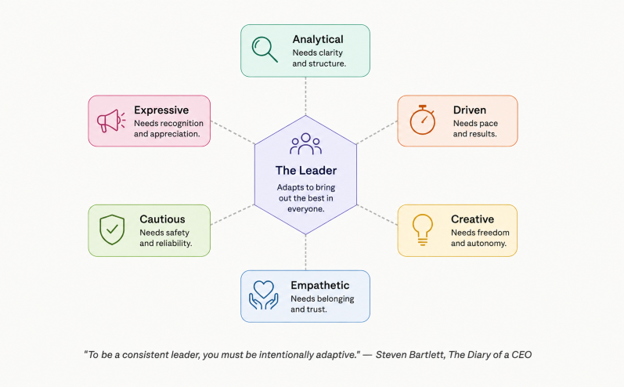
It is impossible, he argues, to fit seamlessly into a team unless a leader first understands the unique shape of each of its members; and then adapts accordingly. The truly effective leader is not consistent.
They are deliberately, skillfully inconsistent: adjusting their emotional register, their communication style, and their expectations to draw out the best from each individual. "To be a consistent leader," Bartlett writes in The Diary of a CEO: The 33 Laws of Business and Life, "you must be inconsistent."
As autocratic leadership, the command-and-control model built for a workforce that no longer exists, is being actively called out and rejected by employees; this reframing needs to be understood by managers today.
Our course, MBA in Leadership & Management at VIT Australia focuses a lot on skills that need to be harnessed by the leaders of today. Particularly, in one of the modules that focus on Organisational Change Development, leaders are educated on how to diagnose and reflect on reactions to change and transition on both a personal and organisational level and the impact this has.
Why Emotional Intelligence Has Become Non-Negotiable
Emotional intelligence, broadly defined as the ability to perceive, understand, manage, and use emotions effectively in oneself and others, has long been discussed in leadership circles.
What has shifted in recent years is the weight of evidence behind it.
Gallup's latest 2025 State of the Global Workplace Research found that 70% of team engagement is directly attributable to the manager, making emotional intelligence the central variable in whether teams perform. That puts the manager as the primary determinant of organisational health.
The findings grow more striking when examined alongside research on conflict.
According to O.C. Tanner's 2025 Global Culture Report, leaders with high emotional intelligence are more than 40 times more likely to have effective approaches to conflict management than those who score low.
And yet, at precisely the moment organisations need emotionally intelligent leadership most, a troubling countertrend has emerged.
A peer-reviewed analysis of 28,000 adults across 166 countries, published in Frontiers in Psychology in November 2025, found a statistically significant 5.79% global decline in EQ scores between 2019 and 2024, with the sharpest drops recorded in self-motivation and emotional self-awareness. The researchers described this as an "Emotional Recession", a genuine degradation in the collective human capacity for the very skills that underpin trust, collaboration, and effective leadership.
The conclusion for organisations is uncomfortable but clear: emotionally intelligent leadership cannot be assumed. It must be developed.
What are the 3 Models of EQ
Before organisations can develop emotional intelligence in their leaders, they need to understand what they are actually developing. Academic research has produced three dominant models of EQ, each offering a different lens.
The Ability Model, pioneered by psychologists Peter Salovey and John Mayer, treats EQ as a form of intelligence. A cognitive capacity to perceive, use, understand, and manage emotional information. Under this framework, EQ can be measured much like IQ, and it exists independently of personality traits. It is the most scientifically rigorous of the three models and forms the foundation for many assessment tools used in organisational settings today.
The Trait Model, associated with researcher Konstantinos Vasilis Petrides, conceptualises EQ as a constellation of emotional self-perceptions that sit within the personality domain. Rather than measuring what people can do with emotions, it measures how people perceive their own emotional tendencies. This model predicts behaviour across a wide range of contexts and has proven particularly useful for understanding how leaders operate under sustained pressure.
The Mixed Model, most closely associated with Daniel Goleman's widely influential work, combines cognitive abilities with personality traits and learned behaviours. Goleman's framework, which includes self-awareness, self-regulation, motivation, empathy, and social skills, is the model most widely adopted in corporate leadership development programmes. It is practical, teachable, and directly applicable to the managerial challenges organisations face day to day.
Each model illuminates a different dimension of emotional competence. The most effective leadership development programmes draw on all three.
The Four Cornerstones of EQ in Practice
Translating theory into practice, contemporary leadership frameworks have distilled emotional intelligence into four core capabilities that every global manager must develop:
Aware — Know Your Own Emotions.
Before a leader can manage others, they must understand their own emotional patterns. What triggers them, how stress manifests in their behaviour, and where their blind spots lie.
Connect — Understand Others' Emotions.
The capacity to read emotional cues, understand the emotional context in which team members are operating, and respond in ways that build rather than erode trust. In diverse, cross-cultural teams, this capability is particularly critical.
Manage — Monitor Your Own Emotions.
Research published in Frontiers in Psychology found that leaders who regularly demonstrate trust and empathy-building behaviours experience turnover rates 40% lower than their peers, along with higher productivity and satisfaction.
Achieve — Direct Emotions Positively.
The highest-order capability is harnessing emotions, both one's own and the team's, in service of purpose and performance. This includes sustaining motivation during uncertainty, channeling conflict productively, and inspiring collective action toward shared goals.
Leaders who invest in all four build the integrated emotional competence that separates good managers from genuinely great ones.
Six Leadership Competencies That Actually Move the Needle
Research and practice have converged on six specific competencies through which emotional intelligence most powerfully shapes leadership outcomes. Each is teachable. Each is measurable.
Personal Influence is the ability to shift perspectives and drive change through relationships and credibility rather than authority. In flat, matrixed, or global organisations, where formal power is distributed, personal influence is often the primary currency of leadership.
Inspiration is the capacity to connect day-to-day work to meaning and purpose. Gen Z employees, in particular, prioritise purpose-driven work and seek authentic connections with colleagues and leaders, often favouring collaborative and empathetic leadership styles over traditional hierarchical models.
Collaboration across functions, geographies, and cultural backgrounds has become a baseline expectation of senior leadership.
Change Leadership demands the ability to hold ambiguity, manage the emotional climate during uncertainty, and sustain trust when the path forward is unclear. According to Deloitte's Global Human Capital Trend, organisations are increasingly prioritising leaders who can create connection, psychological safety, and adaptability during periods of disruption.
Healthy Conflict distinguishes emotionally intelligent leaders from those who mistake harmony for health. The ability to name tension, navigate disagreement, and move a team through productive conflict without rupturing relationships is one of the rarest and most valuable leadership skills in any organisation.
Team Leadership — the capacity to build, develop, and sustain high-performing teams over time is the ultimate expression of EQ in action. It encompasses all of the above and translates them into consistent, day-to-day behaviour.
Conclusion
For multinational corporations, large organisations and aspiring founders, the development of emotionally intelligent managers is a long-term strategic investment.
VIT's MBA in Leadership and Management is designed with exactly this context in mind. The program equips future leaders with the strategic, human, and decision-making competencies required to lead in complex, multicultural environments. The course integrates leadership theory with the kind of applied EQ development that global organisations are actively seeking in their next generation of managers. For professionals who understand that the future of leadership is both emotionally and strategically intelligent, it represents a purposeful next step.